What is ASI (artificial superintelligence)?
Artificial superintelligence (ASI) would be a machine that outthinks the best people across nearly all fields, not in one task. Nick Bostrom's 1998 definition is "an intellect that is much smarter than the best human brains in practically every field".
Updated
ASI means superintelligence built as a machine
Artificial superintelligence (ASI) is the machine form of superintelligence. In 1998 the philosopher Nick Bostrom defined a superintelligence as "an intellect that is much smarter than the best human brains in practically every field, including scientific creativity, general wisdom and social skills". He added that the definition "leaves open how the superintelligence is implemented" and "whether the superintelligence is conscious". His 2014 book Superintelligence: Paths, Dangers, Strategies returned to the topic.
Speed alone can count as weak superintelligence
Bostrom's 1998 paper uses the term "weak superintelligence" for "an intellect that has about the same abilities as a human brain but is much faster". In a postscript dated 30 October 2005 he described "strong superintelligence that was not only faster but functionally superior to human intelligence". The older idea behind both is I. J. Good's "intelligence explosion": machines designing better machines.
ASI sits one step above AGI
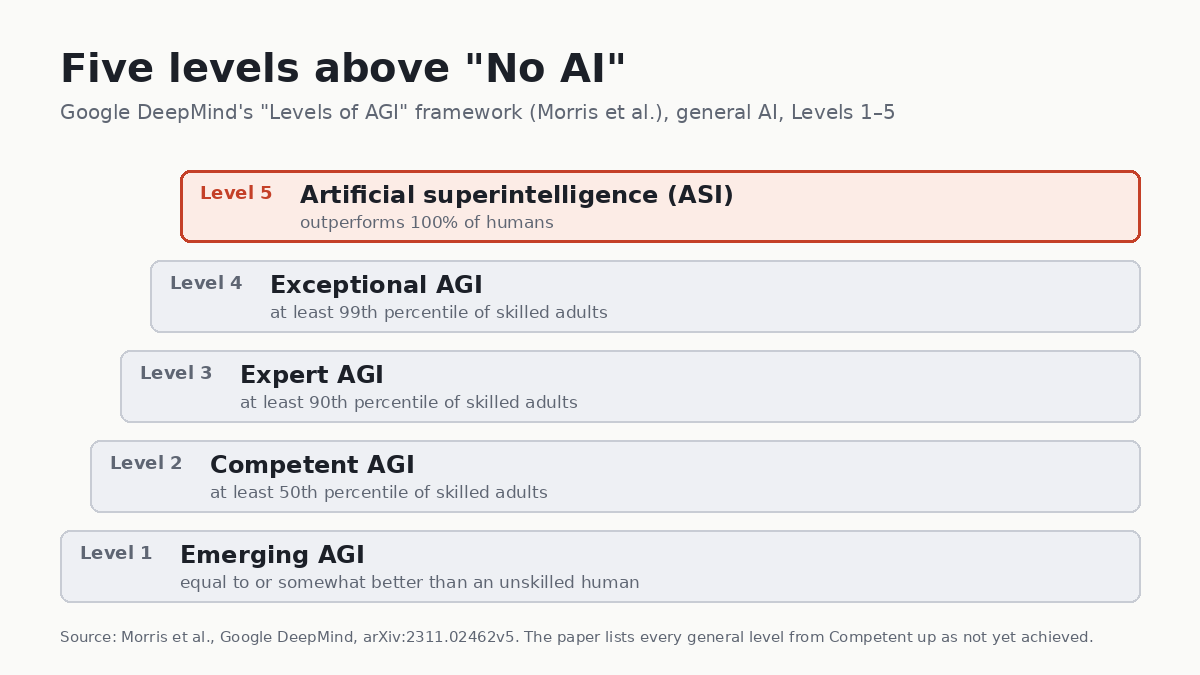
Researchers at Google DeepMind proposed a ladder of AI levels in their paper "Levels of AGI for Operationalizing Progress on the Path to AGI". The top level for general AI is ASI, and the paper defines its "Superhuman" performance as "outperforming 100% of humans". Such systems "will be able to do a wide range of tasks at a level that no human can match". The paper lists it as "not yet achieved". AGI and ASI are compared side by side on the AGI vs ASI page.
What would count as reaching ASI
Bostrom's bar is breadth: a system that beats every human at one task does not meet it. His paper says groups such as companies or "the scientific community" do not count either, because "they are not intellects and there are many fields in which they perform much worse than a human brain".
The DeepMind paper turns the bar into a measurement. Above the first level, its percentiles "are in reference to a sample of adults who possess the relevant skill". It already places AlphaFold at the "Superhuman Narrow AI" level because it predicts protein structures "above the level of the world’s top scientists". ASI would need that across a wide range of tasks. The authors add that ASI may also do things people cannot do at all, since "the ability to execute tasks that qualitatively differ from existing human skills would by definition outperform all humans".
There is no agreed test yet. The authors write that "we do not propose a benchmark in this paper", and that "It is impossible to enumerate the full set of tasks achievable by a sufficiently general intelligence", so "an AGI benchmark should be a living benchmark". How many tasks a system must pass is "an open research question".
What labs say about ASI
In May 2023 OpenAI's leaders described superintelligence as "future AI systems dramatically more capable than even AGI" and wrote that "it’s conceivable that within the next ten years, AI systems will exceed expert skill level in most domains".
Anthropic's 2023 statement of its safety views does not use the word, but it describes pessimistic scenarios in which AI safety is unsolvable because "we cannot control or dictate values to a system that’s broadly more intellectually capable than ourselves".
Mark Zuckerberg wrote in a letter dated 30 July 2025 that "Developing superintelligence is now in sight" and that "Meta's vision is to bring personal superintelligence to everyone". He also wrote that "superintelligence will raise novel safety concerns".
Safe Superintelligence Inc. (SSI) says on its site that "Superintelligence is within reach" and that it has "one goal and one product: a safe superintelligence". More on the company is on the SSI page.
Each lab's own label and goal is compared on the labs page, and Elon Musk's term is explained on the digital superintelligence page.
Self-improvement and scaling are the proposed routes
One proposed route is AI that improves AI. Bostrom's 1998 paper argues that "Once artificial intelligence reaches human level, there will be a positive feedback loop that will give the development a further boost", in which "AIs would help constructing better AIs, which in turn would help building better AIs, and so forth".
Two lab leaders say early versions of that loop exist. In "The Gentle Singularity" (10 June 2025), Sam Altman wrote that AI tools "will help us find further scientific insights and aid us in creating better AI systems", and called this "a larval version of recursive self-improvement", while noting it "isn’t the same thing as an AI system completely autonomously updating its own code". In his 30 July 2025 letter, Zuckerberg wrote that Meta has "begun to see glimpses of our AI systems improving themselves" and that "The improvement is slow for now, but undeniable".
The second route is scale. Anthropic's 2023 safety statement says "research on “scaling laws” demonstrates that more computation leads to general improvements in capabilities", and that "feedback loops from the use of advanced AI in AI research could make this transition especially swift". It also says "AI progress might slow or halt, but the evidence suggests it will probably continue".
Labs name science, health and abundance as benefits
OpenAI's 2023 governance post says that with superintelligence "We can have a dramatically more prosperous future; but we have to manage risk to get there". Altman's 2025 essay predicts that in the 2030s "intelligence and energy—ideas, and the ability to make ideas happen—are going to become wildly abundant".
Anthropic's CEO, Dario Amodei, set out a longer list in his October 2024 essay "Machines of Loving Grace". He writes about "powerful AI" rather than superintelligence, and says "I dislike the term AGI". He describes a system that is "smarter than a Nobel Prize winner across most relevant fields". His "basic prediction" is that AI-enabled biology and medicine "will allow us to compress the progress that human biologists would have achieved over the next 50-100 years into 5-10 years".
Zuckerberg wrote that he is "extremely optimistic that superintelligence will help humanity accelerate our pace of progress".
Published forecasts disagree on timing
In a postscript dated 12 March 2008 Bostrom wrote: "I would all-things-considered assign less than a 50% probability to superintelligence being developed by 2033".
Amodei wrote in October 2024 that powerful AI "could come as early as 2026, though there are also ways it could take much longer". Altman wrote in June 2025 that "2026 will likely see the arrival of systems that can figure out novel insights". Zuckerberg wrote that "The rest of this decade seems likely to be the decisive period for determining the path this technology will take". The history of the idea is on the superintelligence page.
Labs and researchers flag safety risks
The DeepMind paper says the "“Exceptional AGI” and “ASI” levels are where many concerns relating to x-risk are most likely to emerge". OpenAI's 2023 post says "we need the technical capability to make a superintelligence safe" and calls this "an open research question". The arguments for and against are on the safety debate page.
Questions
What does ASI stand for?
ASI stands for artificial superintelligence: superintelligence in a machine. In 1998 Nick Bostrom defined a superintelligence as "an intellect that is much smarter than the best human brains in practically every field".
What is the difference between superintelligence and ASI?
Superintelligence is the wider idea. Bostrom's 1998 definition "leaves open how the superintelligence is implemented", so it could in principle be biological. ASI is the machine form.
Is ASI the same as AGI?
No. In Google DeepMind's levels framework, the AGI levels run from Emerging to Exceptional, and ASI is the level above them, for general AI that is "outperforming 100% of humans".
Does ASI exist yet?
Google DeepMind's levels paper lists artificial superintelligence as "not yet achieved".
Who is building ASI?
Several companies say superintelligence is their goal. Safe Superintelligence Inc. says it has "one goal and one product: a safe superintelligence", and Mark Zuckerberg wrote that "Meta's vision is to bring personal superintelligence to everyone". The labs page compares their wording.
Sources on this page
- Nick Bostrom, "How long before superintelligence?" (1998)
- Wikipedia, Superintelligence: Paths, Dangers, Strategies
- I. J. Good, "Speculations Concerning the First Ultraintelligent Machine", Advances in Computers 6 (1966)
- Morris et al., Google DeepMind, Levels of AGI for Operationalizing Progress on the Path to AGI, arXiv (v5, revised 24 September 2025)
- OpenAI, Governance of superintelligence, 22 May 2023
- Anthropic, Core views on AI safety, 8 March 2023
- Mark Zuckerberg, Meta, 30 July 2025
- Safe Superintelligence Inc.
- Sam Altman, The Gentle Singularity, 10 June 2025
- Dario Amodei, Machines of Loving Grace, October 2024